Panelled Refrigerator Door No Longer Seals
| Reading | Likely cause | Owner check | Price band |
|---|---|---|---|
| Door sits low at the handle side, out of line with the cabinet | Hinge screws loosened over time, or the door dropped out of square | Stand back and compare the door edge with the cabinet line beside it | Quoted after the diagnosis |
| Gasket folded, flattened or split along one stretch | Gasket worn, dirty or rolled over on itself | Clean it and run a finger along it for folds and splits | Quoted after the diagnosis |
| Door stops just short of closing, or drifts back open | Unit shifted out of level, or something inside holding the door off | Look for a bin or shelf in the way before anything else | Quoted after the diagnosis |
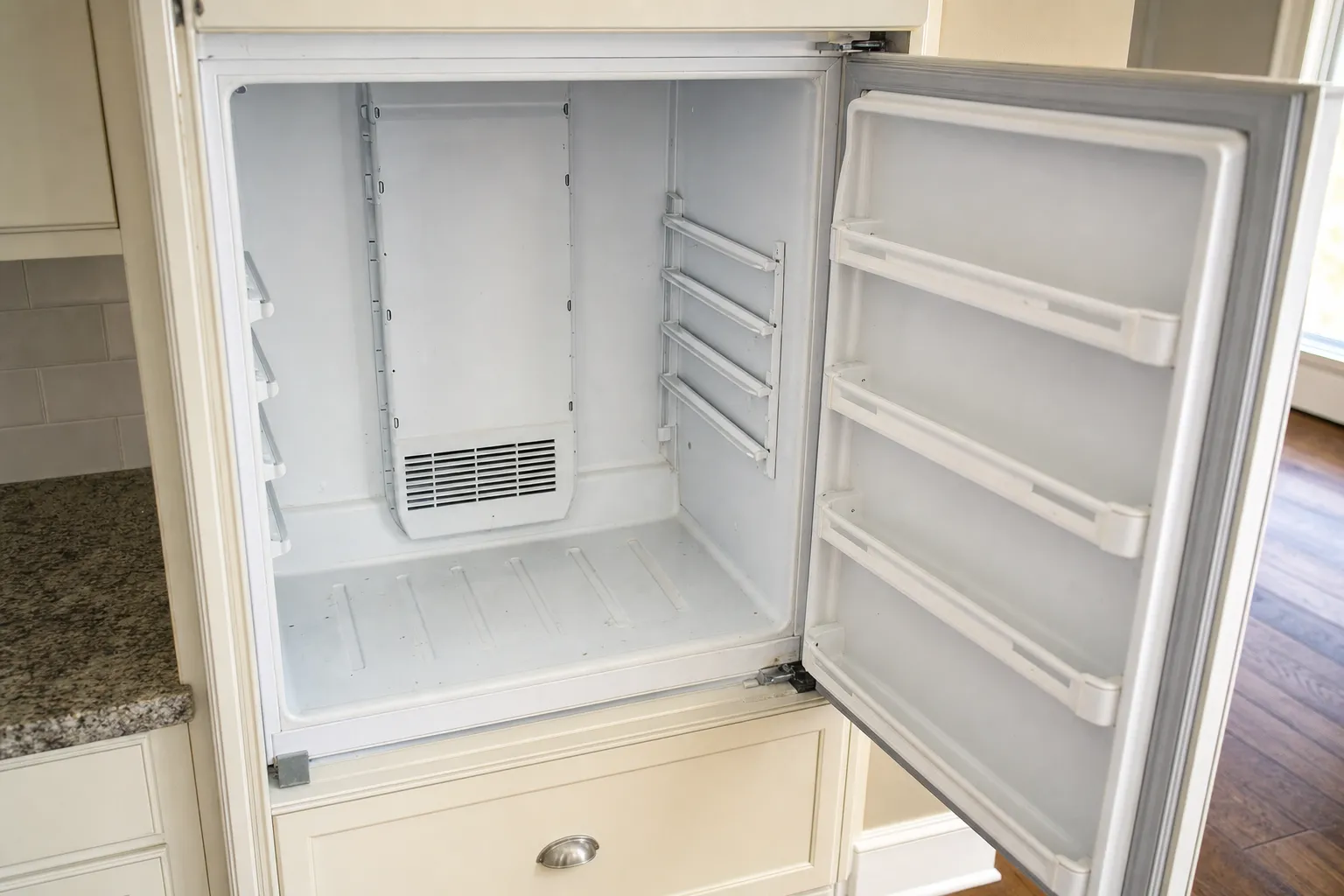
The door wearing the wood panel no longer pulls tight to the cabinet. The hinge carries that panel on every swing; sometimes it is the gasket or the level instead.
The panel, the hinge and the gasket underneath
Row one is usually the panel’s doing. A custom panel is hung on the door, so every opening loads the hinge with both, and a door pulled wide or used as a leaning post adds more. Over the years a hinge can loosen and the door can drop at the handle side. On a 5 Series built-in, for one, the door is squared at the hinge with the unit’s top taken off, a step Viking’s installation guide gives to the installer, so this is a visit rather than a screwdriver job.
The second row is the gasket itself. Viking warns against waxes, strong detergents and bleach on door seals, and suggests a light film of petroleum jelly to keep them supple. A seal that has gone hard, torn or taken a permanent fold needs replacing, and there is no published band for it; it is priced once we have seen the door.
The last row is about what the door closes against. A built-in that has settled on its levelling legs, or a bin loaded until it meets a shelf, can hold the door off its seal. Viking’s guide puts it plainly: nothing should stop the doors from closing properly.
Plenty of Stadium District kitchens hide their refrigeration behind panels matched to the cabinets. The door looks shut because the cabinetry around it does, so a warm shelf is often the first sign.
Owner checks, in this order
- Empty any door bin that is packed tight or catching on a shelf, then close the door slowly and watch whether it meets the cabinet squarely.
- Wash the gasket with baking soda in warm water, the way Viking's care guides suggest every three months, and look for folds or splits as you go.
- Shut the door on a sheet of paper at each corner and halfway down each side. Where it pulls out with no resistance, the seal is open there.
- Leave the hinge screws and the panel fixings alone. On a 5 Series built-in, reaching them means taking the unit's top off, which is technician work.
- Stop there. Anything past these checks means panels off or gas and wiring, and that is the $89 visit from Viking Repair Tacoma: (206) 472-1140.
Asked about this one
Does the wood panel wear out the hinge?
It adds to the load. Every swing puts the panel's weight on the hinge along with the door's, and a door that is often leaned on or pulled wide works the hinge harder still. Over years that can let a door drop out of square. Viking Repair Tacoma checks the hinge and the alignment at the $89 visit; ring (206) 472-1140.
What does a door that will not seal lead to?
Kitchen air leaking in along the gap. The cabinet runs longer to keep up, frost gathers near the opening in the freezer, and food nearest the door warms first. None of it is dramatic on day one, which is why a panelled door can go unnoticed for a while behind cabinetry that looks perfectly closed.