Simmer Burner Drops Out on Low
| Reading | Likely cause | Owner check | Price band |
|---|---|---|---|
| Out on low only with the hood up high or a door open | A draught lifting the small flame off the ports | Hood down a speed, nearest door shut, try again | Quoted after the diagnosis |
| Started after a clean or a boil-over | Cap off level, or damp and crust in the ports | Burner cold: dry it, clear the ports, reseat the cap | Quoted after the diagnosis |
| Dies in still air every time, then ticks and relights | The low-flame setting in that burner's valve sits too low | Cook a notch higher for now | Quoted after the diagnosis |
| Goes out and stays out on a range that normally relights | Re-ignition not answering, usually at the electrode | That knob to off at once; use another burner | $180–$440Igniter or burner assembly |
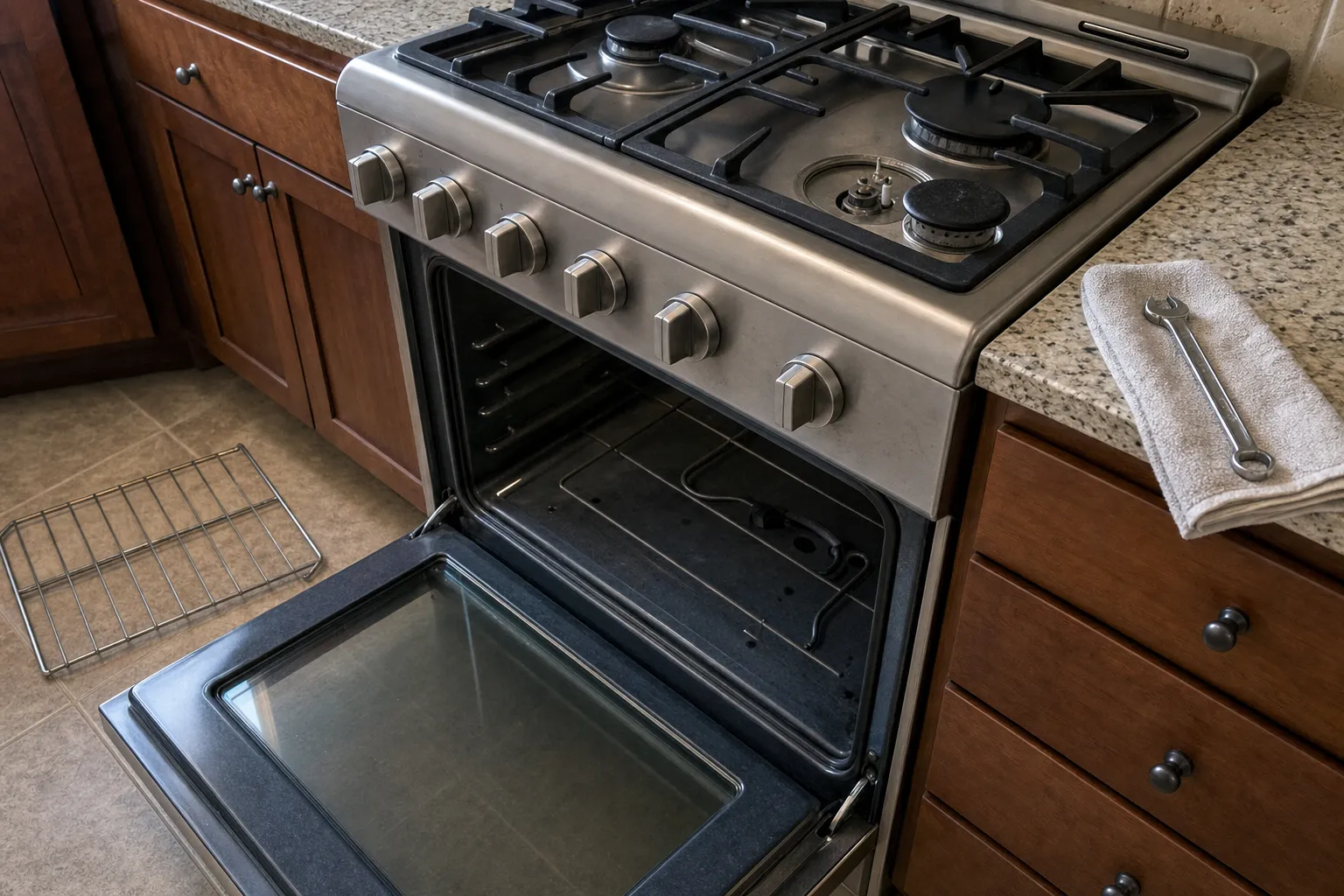
Fine on high, gone on the lowest setting. Often a draught or a cap, sometimes a clogged port, and sometimes the low setting itself needs adjusting.
Why the smallest flame is the first to go
Line one is the usual reason. A simmer flame is tiny on purpose, and it has almost nothing holding it to the ports once air moves across the cooktop. A hood on its top speed does it, and so does an open window beside the range. So does the back door in a compact older Tacoma kitchen, where it can sit a single step from the burners. Nothing is broken, and the price column has nothing to say about it.
The second line comes from cleaning. A tilted cap or a port half shut with spill makes the ring uneven, and the weakest stretch of a low flame is the first to give up.
Line three is the setting itself. The bottom of a Viking dial is a spread of low positions, which Viking calls Vari-Simmer, rather than one notch, and the lowest of them is fixed by a screw inside the valve. Set too low, the flame fails in still air every time, and a range with automatic re-ignition ticks and catches again, over and over. That is an adjustment, priced after the diagnosis.
The last line is the one to act on quickly. A burner that goes dark and stays dark on a range that normally relights has lost its re-ignition, most often at that burner’s electrode, and the knob is still letting gas through. Turn it off first. The electrode sits in the igniter and burner band.
Owner checks, in this order
- Light it on the lowest setting, hood off and doors shut, and give it five minutes.
- Then run the hood at your usual speed, then at its top speed, and see where the flame gives up.
- Once cold, lift the cap, dry cap and burner, clear any closed port with a straight pin, and reseat the cap level.
- Flame out and nothing ticking to relight it? Turn that knob to off straight away and cook elsewhere.
- Stop there. Anything past these checks means panels off or gas and wiring, and that is the $89 visit from Viking Repair Tacoma: (206) 472-1140.
Asked about this one
Can the lowest setting be turned up so it stays lit?
Yes, and it is an adjustment rather than a new part. The low flame is set by a small screw inside the valve stem, and Viking's service literature wants it just reaching the edge of the burner rim and catching at every port. Viking Repair Tacoma checks and resets it during the $89 visit: (206) 472-1140.
Should the ticking on low worry me?
Not by itself. That is re-ignition at work: Viking ranges fitted with it spark again whenever a flame goes out while gas is still flowing. A tick now and then at the bottom of the dial means little. Ticking every few seconds means the flame keeps failing, and the table above says which of the four reasons it is.