Viking Oven Says 350 But Bakes Like 310
| This guide | Fault Guides |
|---|---|
| Appliance | Viking Oven Repair |
| Written by | Hollis Yamada |
| Role | Service technician — refrigeration and cooking |
| In the trade | 21 years in the trade |
| Reading time | 5 min |
| If it needs a visit | $89, credited to the repair |
When a Viking oven reads the right temperature and cooks like it does not, the display is telling you what it was told, not what is true. How to prove the drift, and which part is usually behind it: the sensor, the element or the door.
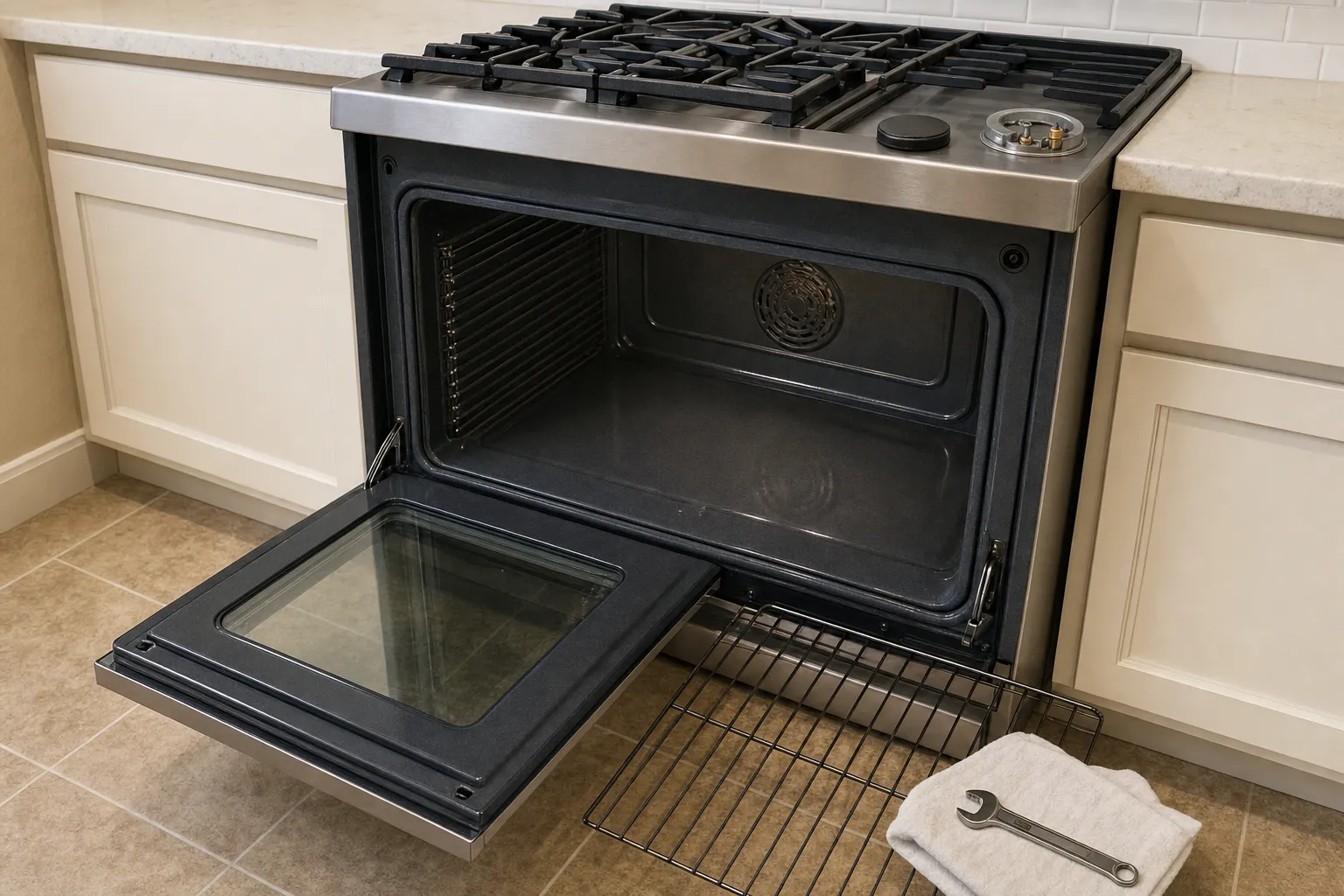
“It says 350, but nothing browns and everything takes half again as long.” That is a fair description of a real fault, usually on a Viking wall oven or the oven side of a pro-style range, and it is worth understanding what the display is actually telling you before you spend money on it.
The number on the front is not a measurement of your oven. It is the number the control board was asked for, cross-checked against one sensor. If that sensor is lying, or the heat is not being delivered where the sensor is not looking, the display will read a confident 350 while your roasting tin sits somewhere else entirely.
What “runs cold” usually means
An oven does not hold a flat temperature. It overshoots the setpoint, cuts the element, coasts down, and fires again. A working oven cycles above and below the number on the front, and the average across an hour is what your food experiences, not any single reading.
So there are three genuinely different faults hiding behind “it runs cold”:
- the average sits low but the cycling looks ordinary — a sensor reading off, or an offset setting
- the swing between hot and cool is far wider than the cycling above — a control or sensor-response problem
- the oven never gets near the setpoint at all — a heating fault, not a sensing one
Those need different repairs, and telling them apart takes one cheap tool and an hour of your time.
Prove the drift before you pay anyone
Buy an oven thermometer — the hanging dial type is fine. Put it in the middle of the centre rack, not touching anything, and set the oven to 350°F on the plain bake setting with no convection.
Let it finish preheating, then wait a further twenty minutes. Ovens declare preheat complete long before the cavity walls and racks are actually up to temperature, which is its own source of bad results. After that, read the thermometer every five minutes for half an hour and write the numbers down.
What you are looking for:
- a set of readings that average close to 350 with ordinary cycling — the oven is fine and the problem is the recipe, the rack position, or the preheat wait
- readings that average well below 350 but cycle tidily — a real, consistent offset
- readings that lurch from far under to far over and back — poor control, not offset
- readings that climb part of the way and stall — a heating fault
Take that list to whoever you call. It changes the conversation from “the oven is broken” to a specific behaviour, and it stops anyone selling you the wrong repair.
The parts that actually cause it
The temperature sensor. A thin probe inside the cavity, usually at the back, and by far the most common cause. These are resistance sensors: their resistance changes predictably with heat, and the board reads that to know the temperature. As they age the curve drifts, and the board dutifully holds the cavity at whatever temperature the drifted reading corresponds to. The oven is doing exactly what it was told, with bad information. This is a modest, tidy repair.
The bake element. On an electric or dual-fuel oven, an element with a dead section gives you an oven that heats slowly and cannot recover after the door is opened. On a gas oven the equivalent complaint is bake that lights late or not at all while the broiler still works; Viking lights its gas ovens with a spark and watches for the flame, so that behaviour has its own page — broil works, bake does not sets out what the technician is looking at.
The door. Any gap at all lets heat straight out of the top. Sagging hinges, a crushed or hardened gasket, or a door that no longer sits flush on one side will all show as an oven that cannot hold temperature and browns unevenly. Look along the closed door edge against a light. It is worth checking before assuming electronics.
The control board. Least common, most expensive, and the one that gets blamed first by shops that have not tested the sensor. If someone reaches for a board on a “runs cold” complaint without putting a meter on the sensor first, that is a warning sign.
Convection ovens have an extra failure mode
If your oven has a convection fan and the results changed specifically on convection settings, add two more suspects.
The convection fan motor can fail or slow down without stopping entirely, which leaves you with an oven that heats but no longer distributes. Everything goes back to behaving like a conventional oven, and any recipe relying on the fan’s faster heat transfer comes out underdone.
The other is the convection element, on models where the fan has its own heating ring. It can fail while the main bake element keeps working — so the oven still heats, just far more slowly on the setting you use most. Both are diagnosable in one visit.
Also worth knowing: moving air cooks faster, so convection recipes usually call for a lower set temperature, and some ovens make that reduction for you. If someone recently changed the convection mode or a conversion setting, the oven may be behaving exactly as designed while running cooler than you expect.
When the sensor or the door is the fault
Viking ovens allow a temperature offset to be set — sometimes called calibration — and it has one proper use: an oven that holds a steady temperature at a consistently wrong number. Anything else is a part.
A sensor that is drifting, a door seal that leaks, a weak element and a wild swing all look like an oven that needs its number moved, and none of them is cured by moving it. An offset dialled in over the top masks the symptom for a few weeks while the fault keeps moving, and then the oven is off true twice over. Test the sensor with a meter and look at the door against a light first.
Call someone out when the oven stalls well below the setpoint, when the swing is wide, when preheat has become noticeably slower than it used to be, when the door does not sit flush, or when the oven went strange straight after a self-clean cycle. Have your thermometer readings and the model number from the rating plate to hand, and the visit will be short.
Asked after reading this
How much drift is normal in a working oven?
Some swing is normal: the oven cycles its element on and off around the target, so a single reading will always be above or below the number you set. Judge it on the average across a full hour of readings instead. What is not normal is an average that sits consistently low, or consistently high, whatever the setting.
How do I tell a failing sensor from a leaking door?
A leaking door shows at the top edge: heat you can feel there, uneven browning toward the front, and a door that does not sit flush against the frame. A drifting sensor leaves the door cool and the cavity steady, just at the wrong number. A meter on the sensor settles it, and that is part of the visit.
Why did it get worse after the self-clean cycle?
Self-clean runs the cavity far hotter than normal cooking, for hours, and it is a genuine stress test for the thermal fuse, the door hinges, the gasket and the control board. A part that was already marginal often declares itself right afterwards, which is why an oven can go into a clean cycle working and come out of it wrong.