A Wall of Frost at the Back of the Freezer
| Reading | Likely cause | Owner check | Price band |
|---|---|---|---|
| Even white sheet over the back wall, a little thicker every week | The defrost heater, or a part that tells it when to run, has failed | Note how far the sheet reaches and whether anything has gone soft | $270–$650Refrigeration fan or defrost system |
| Frost heaviest near the door, loose and feathery | Door or gasket letting kitchen air in; its moisture freezes on arrival | Look for a basket or bag that stops the door sitting flush | Quoted after the diagnosis |
| Frost at the back, with ice or water pooled lower down | Melt water cannot get away: the drain has frozen over or blocked | Wipe up what you can reach and note how soon it comes back | $270–$650Refrigeration fan or defrost system |
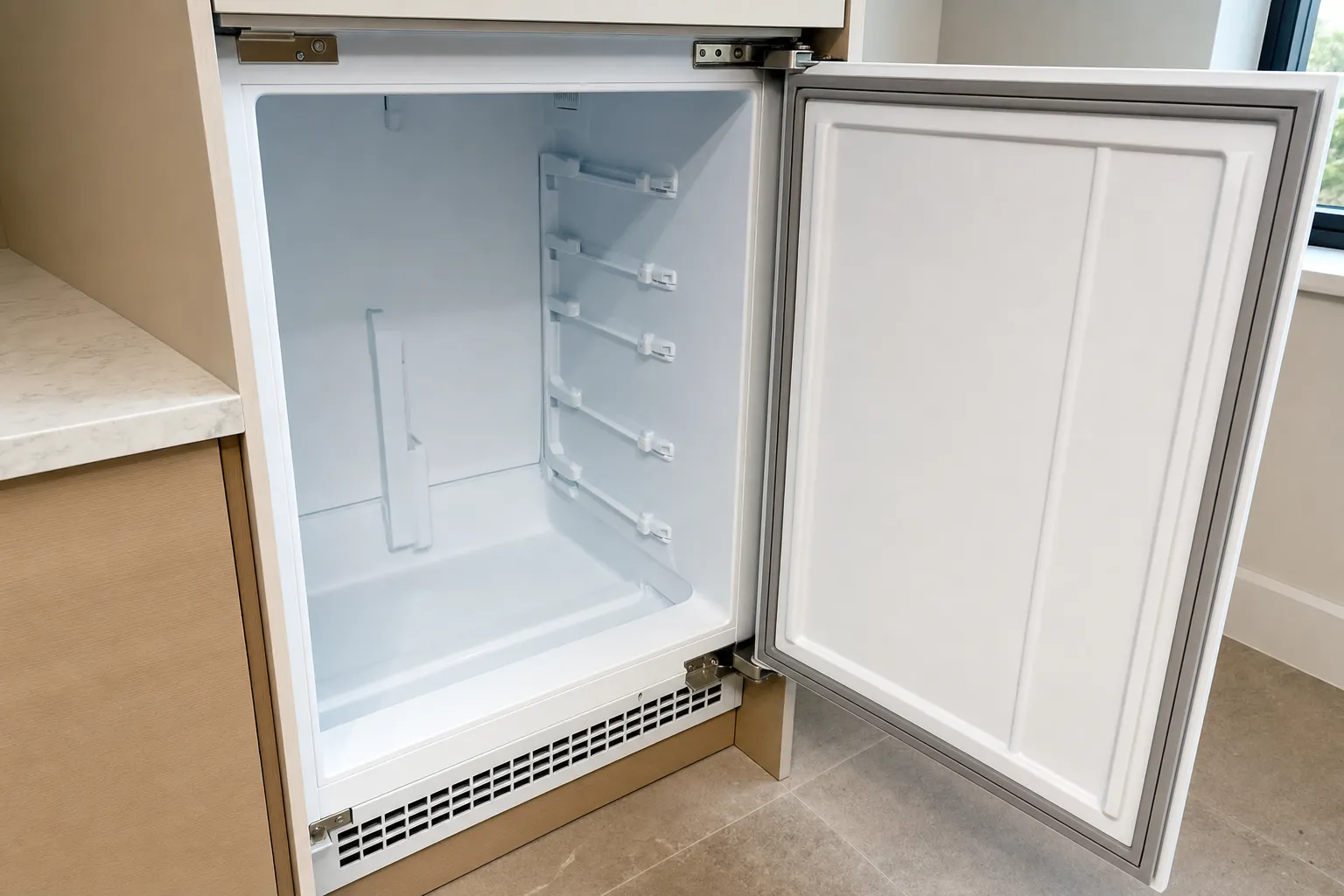
A sheet of frost spreading over the back wall of the freezer. Either the defrost cycle has quit or damp kitchen air is finding its way in round the door.
The first row points inside the machine. A frost-free freezer keeps its coil clear by warming it now and then with a defrost heater; Viking even lists the heater’s sizzle and pop among a built-in’s ordinary noises. When the heater, or whatever decides when it runs, gives up, frost that should melt keeps stacking until it covers the back wall and chokes the airflow. The part is priced in the refrigeration fan or defrost band.
Row two comes from outside the freezer. Kitchen air carries moisture, and wherever it slips past the door it freezes on the nearest cold surface, which is why this frost gathers by the opening. A door held off its seal by an overfilled basket, or a folded gasket, is the usual cause, and neither has a published band.
The bottom row is row one with a drain problem added. Melt water that cannot leave freezes where it lands, then builds on itself cycle after cycle. Clearing the drain and finding out why it froze belong to the same band as the heater.
Column or drawer, the same three rows
It makes no difference whether the freezer is its own Viking column, as in a lot of full kitchens in Northeast Tacoma and Lakewood, or the drawer under a bottom-freezer built-in. The table reads the same. What changes is how the parts are reached, so say which one you have when you book.
Owner checks, in this order
- Open the freezer and look for a basket, bag or ice drawer sitting proud of the front. Anything in the way holds the door off its seal.
- Take a sheet of paper round the door edge, shutting the door on it every hand's width. Wherever it slides out freely, air is getting in.
- Think back over the week. Long or frequent openings can frost a healthy freezer, and Viking's troubleshooting asks about them first.
- Leave the ice where it is: no knife, scraper or hair dryer. Viking warns against forcing the defrost by any method it does not recommend.
- Stop there. Anything past these checks means panels off or gas and wiring, and that is the $89 visit from Viking Repair Tacoma: (206) 472-1140.
Asked about this one
If I thaw the freezer out, is that the fix?
A full thaw, with the freezer emptied and switched off, clears the sheet and buys some time at the cost of the contents. It does not mend a heater or a drain that has failed, so the frost grows back. Viking Repair Tacoma can name the failed part at the $89 visit instead; the number is (206) 472-1140.
Is a little frost normal in a built-in freezer?
A light dusting after a long opening on a muggy day is ordinary and tends to fade on its own. A sheet that thickens from one week to the next, hides the back wall or creeps across the vent is a different matter, and it belongs to the first or the last row of the table above.